
Height Gauges

Pay in 3 interest-free payments on purchases from £20-£3000 with  . Learn more.
 Loading...
End of content
Error - No more pages to load
About Height Gauges
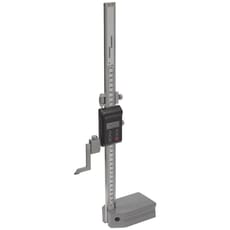
Height gauges are precision measuring instruments essential for determining vertical distances on workpieces with exceptional accuracy. These metrology tools feature a graduated vertical beam mounted on a stable base, with a measuring head that slides along the beam to record precise measurements. Available in both digital and analogue formats, height gauges are indispensable in engineering workshops, quality control departments, and manufacturing facilities where exact vertical measurements are critical. MyToolShed.co.uk stocks professional-grade height gauges including digital models that offer enhanced readability, data recording capabilities, and features such as zero-setting and millimetre-to-inch conversion.
Modern digital height gauges provide resolution of 0.01mm with excellent repeatability, making them suitable for component inspection, layout work, and dimensional verification. These tools work in conjunction with a surface plate or granite table, which provides the flat reference plane necessary for accurate measurements. Professional models feature hardened measuring faces, fine adjustment mechanisms, and robust construction to maintain accuracy even in demanding workshop environments.
Applications
Height gauges are used across numerous precision engineering and manufacturing applications:
- Precision Engineers: Component inspection and verification during manufacturing processes
- Quality Control Inspectors: Verifying finished parts meet dimensional tolerances specified in technical drawings
- Tool and Die Makers: Setting up and measuring tooling components with extreme accuracy
- Machinists: Layout work, setting up workpieces on machine tools, and verifying machined dimensions
- Metrology Technicians: Comprehensive measurement and calibration programmes
- Automotive and Aerospace Workshops: Measuring components that must meet stringent specifications
- Educational Institutions: Technical colleges and apprenticeship programmes teaching precision measurement techniques
Choosing The Right Height Gauges
Measuring Range: Consider the maximum height you need to measure. Standard models typically range from 300mm to 600mm. Ensure the capacity comfortably exceeds your typical workpiece dimensions.
Digital vs Analogue: Digital height gauges offer easier reading, data output capabilities, and features like zero-setting and unit conversion. Analogue vernier models are more economical, require no batteries, and are reliable for basic applications where data recording isn't required.
Accuracy Requirements: Professional applications typically require resolution of 0.01mm with repeatability of ±0.02mm. Consider whether you need calibration certificates traceable to national standards for quality-critical work.
Construction Quality: Look for hardened steel construction, precision ground measuring faces, and robust column design. The base should provide stability, and all moving parts should operate smoothly without play. MyToolShed.co.uk offers reliable brands like Sealey that provide professional-grade accuracy at competitive prices.
Frequently Asked Questions
Do I need a surface plate to use a height gauge?
Yes, a precision-ground surface plate is essential for accurate height gauge measurements. The surface plate provides the flat reference plane from which all vertical measurements are taken, ensuring reliable and repeatable results.
What's the difference between digital and vernier height gauges?
Digital height gauges display measurements on an LCD screen and offer features like data output, zero-setting at any position, and unit conversion. Vernier models use a traditional graduated scale requiring manual reading but are more economical, require no batteries, and are perfectly adequate for applications where data recording isn't needed.
How often should height gauges be calibrated?
For quality-critical applications, annual calibration against traceable standards is typically recommended. However, frequency depends on usage intensity and the criticality of measurements. Workshops with ISO 9001 certification or producing safety-critical components may require more frequent calibration.