
Blue Spot Detectors & Testing Tools

Loading...
End of content
Error - No more pages to load
Blue Spot Detectors & Testing Tools at MyToolShed.co.uk
Blue Spot Detectors & Testing Tools are practical checking instruments for electricians, maintenance engineers, builders and DIYers who need to confirm that a circuit or cable is safe before work begins. The focus here is on voltage testers, which give a quick, clear indication of whether a live supply is present.
Whether you are isolating a circuit to swap a socket, fault-finding on site or running a final check before closing up a wall, these testers fit easily into a tool pouch or van toolkit.
Blue Spot Detectors & Testing Tools Features and Benefits
- Clear visual indication: LED or lamp indicators show at a glance whether voltage is present, so you can make a quick decision without interpreting complicated readings.
- Compact, pocket-sized design: Slim bodies and pen-style formats slip into a pocket or pouch, so a tester is always to hand when you need to prove a circuit dead.
- Suitable for UK mains supplies: Testers are intended for everyday work on 240v circuits, covering sockets, switches, light fittings and appliance connections.
- Simple operation: Minimal controls mean little setup. That saves time on repetitive checks and suits both trade users and less experienced DIYers.
- Insulated, hard-wearing construction: Robust housings and insulated grips stand up to knocks on site and help protect your hands when probing.
Popular Blue Spot Detectors & Testing Tools
Voltage Testers
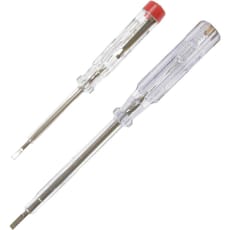
Voltage testers are the core of Blue Spot's detecting and testing offer. Typical formats include pen-style testers for fast non-contact or contact checks, and screwdriver-style testers for testing terminals and fittings. They suit tasks such as:
- Confirming a socket or switch is isolated before replacing it
- Checking lighting circuits before fitting new fittings
- Identifying live cables behind plasterboard or in consumer unit enclosures
- Routine maintenance checks on appliances and fixed equipment
Always follow safe isolation procedures and check that your tester works on a known live source before and after use.
Frequently Asked Questions
How do I choose the right voltage tester?
Consider where and how you will use it. Pen-style testers are ideal for quick checks and carrying in a pocket, while screwdriver-style testers suit terminal testing and light fixing tasks. Check the voltage range matches 240v domestic and light commercial work, and choose a model with a clear indicator that is easy to read in poor light.
Can I rely on a voltage tester alone to confirm a circuit is dead?
A voltage tester is a helpful first check, but it should be part of a full safe isolation procedure. Prove the tester on a known live source, test the circuit, then re-prove the tester afterwards. For electrical installation work, use equipment that meets the relevant UK standards and follow current regulations.